

Justice Atul Sreedharan Critiques NHRC’s Role in India
 Copy Link
 Share
Share Save
Save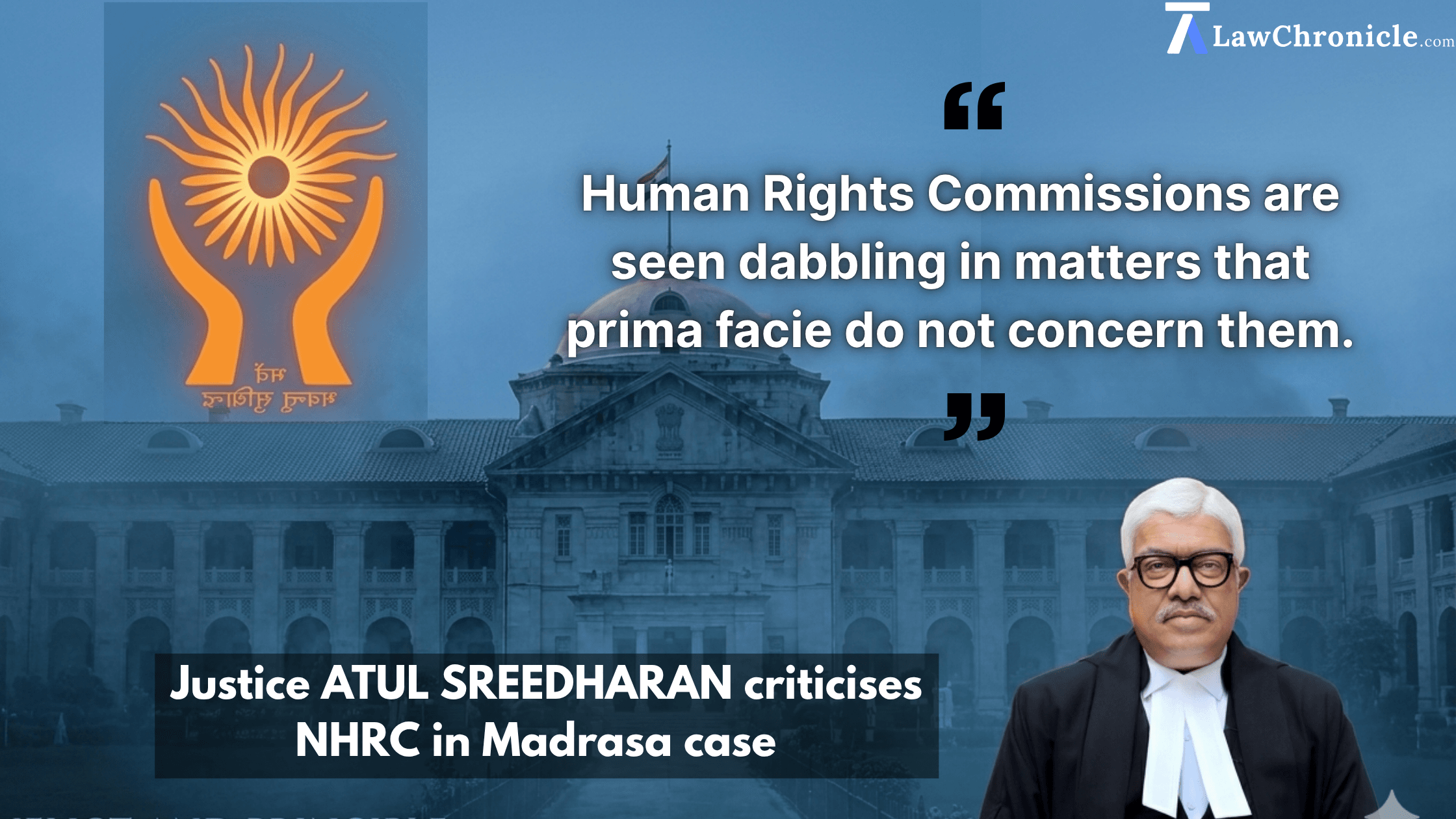
The National Human Rights Commission – NHRC's role in India is under scrutiny. Justice Atul Sreedharan in a recent order made some stringent remarks against the Commission for orders passed in a complaint against aided Madrasas. The matter caught eyes as the other judge on the bench, Justice Vivek Saran, detached himself from Justice Atul Sreedharan’s views by passing a separate order. Here's a detailed understanding of what the Bench said, while looking into the NHRC’s powers and functions as an autonomous body.
Background of the Split Verdict
The matter pertains to a challenge against NHRC’s directive for probe into aided Madrasas in the State of Uttar Pradesh. The allegations in the original matter pertain to financial irregularities and unqualified teachers. The matter caught significant attention when two Judges of the Division Bench passed split interim orders. Justice Atul Sreedharan came down heavily upon the role of National Human Rights Commission (NHRC) and allowed adjournment of the matter, which was the central question for the day.
Justice Vivek Saran agreed with the adjournment being allowed. However, he chose to have a different view against Justice Atul Sreedharan’s strong remarks on the role of the NHRC. He opined that if any such order containing adverse observations had to be passed, it should have happened in the presence of all the parties.
Justice Atul Sreedharan’s Key Observations on NHRC
As mentioned earlier, the State in this case strongly opposed adjournment sought by the petitioners. It was submitted by State that the matter involves crores of rupees, while D.G, Economic Offences Wing, Govt. of U.P has been directed by NHRC to inquire and file a report. The complaint stated 588 Madarsas in collusion and involvement of State Minority Department receive grants but do not meet any standards, have illiterate teachers, lack basic education, infrastructure, etc., teachers allegedly recruited on bribes, thereby seeking NHRC’s intervention.
Questions Raised Over NHRC’s Role
The Court was “astounded by the order passed by the NHRC”. Justice Atul Sreedharan pointed at the powers of National and State Human Rights Commissions as per the Protection of Human Rights Act, 1993, to be specific to violations of human rights. On the orders passed by NHRC in the instant case, Justice Atul Sreedharan expressed doubt on the directions so issued for executive officers to act in a particular manner, to add further, “in a case where human rights are not involved”. The Court was of the view that nature of the case reflects that it should have been agitated vide Article 226 of the Constitution before the High Court.
With even stronger expression on instances of lynching against Muslim community, Justice Atul Sreedharan stated that “Instead of taking suo-motu cognizance in which members of the muslim community are attacked and at times lynched in some cases, and where cases are not registered against perpetrators or not investigated properly, the Human Rights Commissions are seen dabbling in matters that prima facie do not concern them.” Justice Atul Sreedharan posed cluelessness on NHRC taking suo motu cognizance of vigilantes, harassing ordinary citizens. He even highlighted instances where people “harass individuals on account of the nature of relationship between persons of different communities or where even having a cup of coffee at a public place with the person of different religion becomes a fearful act.”
Legal Position of the NHRC: Role and Powers
The Protection of Human Rights Act, 1993 is the foundation statute which led to the establishment of National and State Human Rights Commissions. The Act defines what human rights are and empowers NHRC to act on violations of human rights.
Justice Atul Sreedharan highlighted that “if in a particular case where the Human Rights Commission feels that it must intervene in order to protect human rights of the citizens of this Country as defined in Section 2(1)(d), the Human Rights Commissions can themselve becomes complainant before a court of competent jurisdiction by filing a complaint if they so desire, or get an FIR registered as a complainant, where the victim is unable to do so.” As expressed by Justice Atul Sreedharan, prima facie there was no human right involved and NHRC went ahead to entertain the complaint and pass orders.
The Larger Debate
Looking at Justice Atul Sreedharan’s criticism of the role being played by NHRC, the deviance sounds obvious. Economic offences involving crores does not per se fall under human rights violation. Of course, there are several instances of communal lynching which made it to news headlines, but not in the list of suo motu cognizance by the NHRC.
But there is another facet of the instant case, which cannot be ignored. The National Human Rights Commission is an autonomous body. In other words, it is self-governing. Can a High Court Judge question, or for that matter, criticize the role of NHRC, is just another aspect to be looked at.
Since the other Judge on the same bench chose to change paths from Justice Atul Sreedharan’s harsh remarks against NHRC, let’s wait for what unfolds further when NHRC reacts, or replies to it.
 Breaking News